Installation
From Prebuilt Binaries
Go to the latest release page and download the archive corresponding to your Operating System and architecture, then:
tar xvf flowg-${VERSION}-${OS}-${ARCH}.tar.gz
sudo install -m 755 ./bin/flowg-server /usr/local/bin/flowg-server
Adjust the VERSION, OS and ARCH variables to the archive you
downloaded.
Then, start the server with:
flowg-server
For more informations about the command line interface, please consult this document.
For more informations about the configuration, please consult this document.
From Sources
Requirements:
- Go 1.22+
- C Toolchain
- Rust and Cargo (edition 2021)
- NodeJS
- gettext (for
msgcat)
First fetch the source code:
git clone https://github.com/link-society/flowg
cd flowg
Then run the build system:
go install github.com/go-task/task/v3/cmd/task@latest
task build:all
sudo install -m 755 ./bin/flowg-server /usr/local/bin/flowg-server
Then start the server like you would do with prebuilt binaries.
Using Docker
docker run \
  -p 5080:5080/tcp \
  -p 9113:9113/tcp \
  -p 5514:5514/udp \
  -v flowg-data:/data \
  linksociety/flowg:latest
Or if you are on ARM:
docker run \
  -p 5080:5080/tcp \
  -p 9113:9113/tcp \
  -p 5514:5514/udp \
  -v flowg-data:/data \
  linksociety/flowg:latest-linux-arm
The container runs as the non-root user 10001:10001. A named volume
(-v flowg-data:/data, as shown above) inherits the image's ownership and works
out of the box. If you instead bind-mount a host directory
(-v /srv/flowg:/data), run the container as the user that owns that directory
with --user, otherwise the server can't create its data directories on first
boot:
docker run \
  --user "$(id -u):$(id -g)" \
  -p 5080:5080/tcp \
  -p 9113:9113/tcp \
  -p 5514:5514/udp \
  -v /srv/flowg:/data \
  linksociety/flowg:latest
On Kubernetes, the bundled Helm chart already sets fsGroup: 10001 on the pod,
so a freshly provisioned PersistentVolumeClaim is made writable automatically.
Security considerations
By default, the Syslog endpoint is open to everyone. If that behavior is undesirable, you can:
Configure Client certificate authentication
By using the Syslog protocol tcp+tls instead of udp (the default), you can
require Client certificate authentication:
1) Create a configuration file config.hcl:
services {
  syslog {
    protocol = "tcp"

    tls {
      cert = "/path/to/cert.pem"
      key  = "/path/to/cert.key"
      auth = true
    }
  }
}
2) Start the server with the configuration file:
flowg-server --config config.hcl
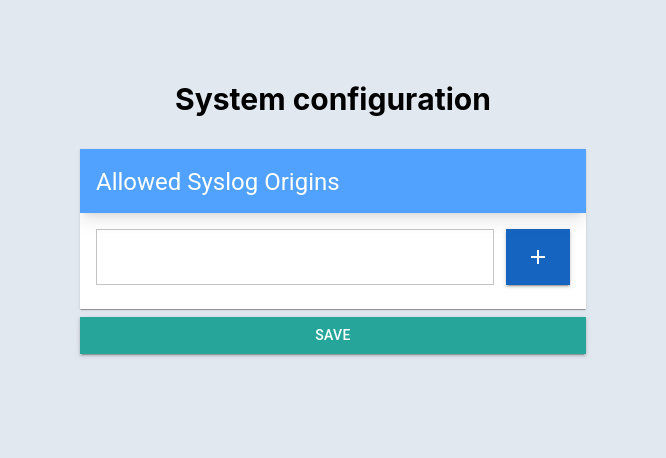
Configure allowed origins
Otherwise, you can restrict which IP address (or range) will be allowed:
Go to Settings > System Configuration > Allowed Syslog Origins and add IPs
Next Steps
Once deployed, FlowG creates a default pipeline and a default account with
the credentials root / root.
You now have access to:
- The WebUI at http://localhost:5080
- The API documentation at http://localhost:5080/api/docs
- The Syslog endpoint at udp://localhost:5514
- The Management API at http://localhost:9113:
/health: health check, always return200 OK/metrics: Prometheus Exporter